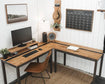
- No products in the cart.




L SHAPED DESKS: THE CORNER-COMMANDING WORKSPACE UPGRADE TRANSFORMING UK HOME OFFICES

16
Aug
Creating a productive workspace is not simply about finding somewhere to put a laptop. Whether you work from home full-time, run a business, study, game, create content or simply need a more organised place for household administration, the size and layout of your desk can make an enormous difference.
For people who need more usable desktop space without allowing a desk to dominate the entire room, L Shaped desks offer an exceptionally practical solution.
The distinctive corner configuration provides two connected working surfaces, allowing you to spread equipment, paperwork and accessories across a much larger area than you would normally have with a conventional straight desk. At the same time, the L-shaped layout can make excellent use of corners that might otherwise remain underused.
This combination of generous workspace and efficient room planning explains why L Shaped desks have become increasingly popular throughout UK home offices, bedrooms, studies, gaming rooms and professional workplaces.
However, choosing the right desk involves considerably more than simply selecting a design that looks attractive.
Dimensions, orientation, storage, legroom, monitor placement, available floor space, cable management and the way you actually work should all influence your decision.
This comprehensive guide explores everything you need to know about L Shaped desks, helping you understand their advantages, decide whether one will fit your room and choose a configuration that supports a more comfortable, organised and productive workspace.
What Are L Shaped Desks?
L Shaped desks are desks constructed with two connected desktop sections positioned at approximately a right angle, creating the characteristic L-shaped footprint.
Rather than providing a single straight working surface, the design extends around the user.
One section might hold your computer and monitors while the second provides space for paperwork, notebooks, equipment, printers or other everyday essentials.
This layout can be particularly useful for anyone who regularly switches between different types of work.
For example, you could dedicate the main section to digital work while keeping the adjoining return clear for handwriting, reviewing documents or taking calls.
Although they are commonly referred to as corner desks, not every L-shaped model must necessarily be pushed directly into a corner. Depending on the design and available room, they can also be positioned along walls or used to partially divide a larger workspace.
Why L Shaped Desks Work So Well in UK Homes
Space is often an important consideration when furnishing British homes.
Many UK properties have bedrooms, spare rooms and studies where every square metre needs to be used intelligently. A large conventional desk positioned along one wall can provide plenty of width, but it may not always make the best use of the room.
L Shaped desks take a different approach.
Instead of extending the entire workspace in one direction, part of the surface turns through approximately 90 degrees.
That can allow the desk to occupy a corner while providing significantly more accessible surface area around the seated position.
This makes an L-shaped desk particularly useful for:
- home offices
- spare bedrooms converted into offices
- dedicated studies
- gaming rooms
- student bedrooms
- creative studios
- commercial offices
- shared family workspaces
- small business offices
- hybrid working environments
The important point is that a larger desktop does not automatically mean inefficient use of space.
The shape of the desk can matter just as much as its overall dimensions.
The Main Benefits of L Shaped Desks
There are several reasons people choose L Shaped desks instead of traditional rectangular alternatives.
More Desktop Space
The most obvious advantage is additional working surface.
A single straight desk can quickly become crowded once you add a monitor, laptop, keyboard, mouse, speakers, documents and everyday office accessories.
Add a second monitor and the available space becomes even more limited.
L Shaped desks provide an additional section that can dramatically increase usable desktop area.
Instead of constantly moving items around to create space, you can organise different pieces of equipment across separate zones.
Excellent Use of Corners
Corners can be surprisingly difficult areas to furnish effectively.
A traditional rectangular desk placed against one wall can leave the neighbouring wall unused. An L-shaped configuration can occupy both sides of the corner, transforming that area into functional workspace.
This can be particularly valuable in smaller UK rooms where efficient furniture placement is essential.
Better Workspace Organisation
A larger surface makes it easier to create clearly defined working zones.
You might use one section for your computer setup and another for administrative work.
Alternatively, one side could accommodate multiple monitors while the other holds a laptop, printer, documents or specialist equipment.
Creating separate zones can reduce clutter and make frequently used items easier to access.
Ideal for Multiple Monitors
Anyone using two or three monitors will understand how quickly screens consume desk space.
L Shaped desks are particularly suitable for multi-monitor setups because the extended surface provides considerably more flexibility when positioning displays.
This is useful for professionals working with spreadsheets, coding, design software, financial platforms, video editing or other applications where multiple screens improve workflow.
It can also make L-shaped configurations attractive for gaming setups.
Everything Can Stay Within Reach
One overlooked advantage is accessibility.
Because the desktop wraps around your seated position, equipment can potentially remain closer to you.
Rather than repeatedly reaching across a very wide straight desk, you can position important items around the two working surfaces.
When planned correctly, this creates an efficient workstation where frequently used equipment is readily accessible.
L Shaped Desks for Home Offices
The growth of home and hybrid working has changed what many people expect from home office furniture.
A small desk might be perfectly adequate for occasional evening emails. It becomes considerably less practical when you spend several hours at it every working day.
L Shaped desks for home offices provide room to build a more complete workstation.
A typical setup might include:
Main workspace:
computer, monitors, keyboard and mouse.
Secondary workspace:
laptop, notebook, documents and phone.
Additional area:
printer, speakers, charging station or other accessories.
Separating these functions can make the workspace feel calmer and more organised.
It can also reduce the temptation to stack paperwork around your keyboard simply because there is nowhere else to put it.
L Shaped Desks for Small Spaces
It might seem logical to assume that L Shaped desks are only suitable for large rooms.
That is not necessarily true.
The important measurement is the desk's footprint relative to the available room.
Compact L Shaped desks can make efficient use of smaller spaces because they utilise two adjoining walls rather than requiring one exceptionally long wall.
However, careful measurement becomes particularly important in a compact room.
Before purchasing, measure:
- the length of both available walls
- the desk depth
- the distance to doors
- nearby radiators
- window positions
- plug sockets
- skirting boards
- wardrobes and cupboards
- the area required for your office chair
- space needed to move behind the chair
Do not simply measure whether the desk itself fits.
You need enough room to comfortably use it.
How to Measure for an L Shaped Desk
Measuring correctly before ordering can prevent one of the most common furniture-buying mistakes.
Start by measuring the two walls where you intend to position the desk.
Record the maximum available length along each wall.
Next, check the depth of the desk you are considering. Remember that the depth affects how far the furniture projects into the room.
Then measure the open area behind your intended seating position.
Your office chair needs sufficient room to roll backwards, rotate and allow you to stand comfortably.
You should also check potential obstructions.
These can include:
- radiators
- windowsills
- doors
- fitted wardrobes
- shelving
- plug sockets
- heating controls
- floor vents
- skirting boards
Creating a temporary outline on the floor using masking tape can be extremely helpful.
Mark the proposed desk footprint and position your chair inside it.
This provides a much clearer impression of how much room the desk will occupy before the furniture actually arrives.
Choosing the Correct L Shaped Desk Orientation
Orientation is one of the most important considerations when buying L Shaped desks.
The shorter or secondary section is often called the return.
Depending on the design, the return may sit on your left or right when you are seated.
Some desks have a fixed orientation.
Others are reversible, allowing the return to be assembled on either side.
Before ordering a fixed configuration, imagine yourself sitting at the main working position.
Would you prefer the additional surface to extend towards your left or your right?
Consider doors, windows, sockets and other furniture when making the decision.
A reversible L-shaped desk provides additional flexibility and can be particularly useful if you expect to rearrange the room or move home in the future.
L Shaped Desks With Storage
Storage can transform a large desktop from a cluttered surface into a genuinely organised workspace.
L Shaped desks with storage may incorporate drawers, shelves, cupboards or open compartments.
Before deciding how much storage you need, think about what you actually keep near your workstation.
Common items include stationery, paperwork, chargers, headphones, notebooks, external drives and office supplies.
If you mainly work digitally, extensive storage may be unnecessary.
If your work involves physical paperwork or equipment, integrated storage could be extremely useful.
The important consideration is not simply storage capacity.
You should also consider where the storage is positioned.
Drawers or cupboards underneath the desk can reduce available legroom, so make sure the configuration still provides a comfortable seated position.
L Shaped Computer Desks
For computer-based work, desktop dimensions are particularly important.
An L Shaped computer desk should provide enough depth for the monitor to sit at a comfortable viewing distance while leaving space for the keyboard and mouse.
Think about everything your setup contains:
computer monitors, laptop, keyboard, mouse, speakers, microphone, docking station, external drives and charging equipment.
A generous surface allows these components to be positioned intentionally rather than squeezed together.
If you use a desktop PC tower, decide whether you want it positioned on the floor, on a dedicated stand or on the desktop itself.
That decision can significantly affect how much usable surface space remains.
L Shaped Desks for Dual Monitor Setups
Dual monitors have become common in both home and professional offices.
An L-shaped configuration can provide the width required for two screens without forcing the entire setup across one long straight surface.
There are several possible arrangements.
Both monitors can sit together on the main section.
Alternatively, one display can sit near the corner while another occupies the adjoining section.
Monitor arms can create even greater flexibility while freeing additional desktop space.
When planning your setup, consider viewing angles as well as available width.
You should ideally avoid repeatedly twisting your neck towards a screen positioned too far to one side.
L Shaped Gaming Desks
Gaming setups can require substantial amounts of space.
Multiple monitors, keyboards, mice, speakers, headsets, microphones, controllers and other equipment can quickly overwhelm a smaller desk.
This is why L Shaped desks for gaming are popular with people who want a spacious setup without necessarily using an extremely long straight desk.
One section can become the primary gaming area while the return accommodates secondary equipment.
The additional surface also provides more flexibility for combining gaming and working within the same room.
You might use one section during the working day and keep gaming equipment organised on the adjoining surface.
L Shaped Desks for Working From Home
A productive work-from-home environment needs to support everyday routines.
If you regularly move between video meetings, focused computer work, phone calls and paperwork, constantly clearing the same small surface can become frustrating.
L Shaped desks can make those transitions easier.
You could maintain a permanent computer workstation while keeping another section available for writing, planning or reviewing documents.
That separation can create a more professional working environment even when the office is located inside a bedroom or spare room.
Modern L Shaped Desks and Interior Design
Practicality is essential, but the desk will also become one of the largest pieces of furniture in the room.
Its appearance therefore matters.
Modern L Shaped desks are available in a wide variety of finishes and styles, making it possible to coordinate the workstation with surrounding furniture.
Popular interior approaches include minimalist workspaces, industrial-inspired offices, contemporary home offices and warmer wood-effect schemes.
Consider how the desktop, frame and storage components interact with flooring, wall colours and other furniture.
A desk does not need to match everything exactly.
A coordinated overall appearance is usually more important than identical finishes.
White L Shaped Desks
White L Shaped desks can work particularly well in modern interiors where maintaining a bright, spacious appearance is important.
Lighter finishes reflect more ambient light and can visually reduce the heaviness of a large piece of furniture.
This can make white desks appealing for smaller home offices, bedrooms and contemporary interiors.
They can also provide a neutral background for monitors, accessories and office equipment.
Black L Shaped Desks
Black L Shaped desks offer a stronger, more dramatic appearance.
They can suit gaming rooms, modern offices and monochrome interiors particularly well.
Dark surfaces can create a defined workstation and pair naturally with black computer equipment and monitor stands.
In smaller rooms, however, very dark furniture can appear visually heavier, so consider the overall lighting and colour scheme.
Wood Effect L Shaped Desks
Wood-effect finishes provide a warmer alternative to plain white or black surfaces.
They can work especially well when the home office forms part of a living space and you want the desk to feel more like furniture than purely office equipment.
Natural-looking finishes can complement shelving, flooring and other wooden furniture while maintaining the practical advantages of an L-shaped workspace.
L Shaped Desks With Shelves
Open shelving can provide useful additional storage without requiring separate furniture.
Shelves may accommodate books, folders, decorative accessories, small office equipment and everyday supplies.
This can be particularly useful where floor space is limited.
However, check the location of the shelves carefully.
A shelving unit underneath the desk might restrict legroom or prevent you from positioning your chair where you naturally want to sit.
Storage should support the workstation rather than dictate an uncomfortable seating position.
Cable Management for L Shaped Desks
A larger workstation often means more electronic equipment.
That inevitably means more cables.
Without planning, cables from monitors, computers, chargers, lamps, speakers and accessories can quickly become tangled.
Useful cable management features include cable holes, under-desk trays, clips and concealed channels.
Even when the desk itself does not include dedicated cable management, you can improve organisation by grouping cables according to their destination and keeping excess lengths secured underneath the desktop.
Consider plug socket positions before assembling the desk.
Positioning the workstation near accessible sockets can dramatically simplify the final setup.
Where Should You Position an L Shaped Desk?
The obvious position is in a corner, but that is not your only option.
In a traditional home office, positioning the desk against two walls usually maximises open floor space.
In a larger room, one side of the desk can project outward and create a partial divider between working and living areas.
Think carefully about natural light.
Placing monitors directly opposite a bright window may create reflections, while positioning the screen with a window directly behind it can create strong contrast.
A side-on relationship to the window often works well.
You should also consider what appears behind you during video calls if online meetings form part of your working day.
L Shaped Desk Versus Straight Desk
Choosing between an L-shaped desk and a straight desk depends largely on your working habits and available room.
Straight desks are simple, versatile and often easier to position.
They may be the better choice where wall space is extremely limited or where the desk needs to remain visually minimal.
L Shaped desks generally provide more usable surface and create stronger working zones.
They can be particularly beneficial for multiple monitors, paperwork-heavy jobs and people who use several devices simultaneously.
The question is not which style is universally better.
It is which configuration fits your room and working habits more effectively.
L Shaped Desk Versus Corner Desk
The terms are often used interchangeably, although there can be subtle differences.
An L-shaped desk normally consists of two elongated surfaces meeting at approximately 90 degrees.
Some traditional corner desks, however, concentrate more of their usable area directly within the corner itself.
When shopping, focus on actual dimensions and configuration rather than relying entirely on terminology.
The product measurements will tell you far more about whether the desk suits your room.
Are L Shaped Desks Good for Productivity?
Furniture alone cannot make someone productive, but workspace design can remove unnecessary friction.
A cramped desk forces you to constantly reorganise items.
Documents cover keyboards. Laptops compete with monitors for space. Chargers become tangled. Notebooks disappear beneath paperwork.
A larger, properly organised L-shaped workspace can reduce these problems.
The additional surface allows you to give important items permanent positions.
That means less time rearranging your desk and more opportunity to concentrate on the task itself.
The key is organisation.
A larger desk filled with unnecessary clutter will not automatically improve productivity.
Creating Work Zones on L Shaped Desks
One of the best ways to use L Shaped desks is to divide them into zones.
For example:
Computer zone – monitor, keyboard, mouse and main computer equipment.
Planning zone – notebook, diary and paperwork.
Communication zone – phone, headset and charging equipment.
Reference zone – documents, books and frequently used information.
Storage zone – stationery and accessories.
You do not need five physically separate areas.
The principle is simply to assign different purposes to different parts of the desk.
This prevents the entire surface becoming one large collection of unrelated items.
How to Choose the Best L Shaped Desks for Your Space
The best desk is not necessarily the largest or the one with the most features.
It is the desk that suits your particular room and working requirements.
Consider these factors before buying:
Overall Dimensions
Measure both sections carefully and compare them with your available floor space.
Desktop Depth
A deeper desktop can provide more comfortable monitor positioning and additional working space.
Orientation
Check whether the desk is left-handed, right-handed or reversible.
Storage
Decide whether drawers and shelves are genuinely useful for your working habits.
Legroom
Check underneath the desk rather than focusing only on the desktop.
Equipment
Calculate how much room your monitors, laptop and accessories require.
Cable Management
Think about how power and data cables will travel from the desk to nearby sockets.
Style
Choose a finish that complements the surrounding room.
Future Requirements
Consider whether your setup may expand.
If you currently use one monitor but expect to add another, buying slightly more desktop space now could prevent another furniture purchase later.
Common Mistakes When Buying L Shaped Desks
One of the biggest mistakes is failing to measure properly.
Another is checking the desk length but forgetting about depth.
A desk may technically fit along both walls while projecting so far into the room that movement becomes difficult.
Orientation is another common issue.
Always confirm which side the return occupies before ordering a fixed-orientation desk.
People also underestimate chair clearance.
Remember that you need space behind the chair, not merely enough room to place it underneath the desktop.
Finally, avoid choosing entirely on appearance.
An attractive desk that does not comfortably accommodate your equipment will quickly become frustrating.
How Much Space Do You Need for an L Shaped Desk?
There is no single minimum room size because L Shaped desks are available in numerous dimensions.
Instead, calculate the complete working footprint.
This consists of the desk itself plus the area required for your chair and movement.
For small rooms, compact designs with relatively shallow desktops may be more appropriate.
For dedicated offices, larger models can provide substantial working areas while still using corners efficiently.
Always compare actual product measurements rather than assuming that labels such as small, compact or large correspond to your available space.
Making an L Shaped Desk Feel Less Cluttered
Large desktops can sometimes encourage people to accumulate unnecessary items.
The easiest way to prevent this is to keep the primary working area deliberately clear.
Store stationery in drawers or organisers.
Route cables underneath the desktop.
Move rarely used equipment away from the immediate workstation.
Use vertical storage where appropriate.
Most importantly, avoid treating the second section as somewhere to permanently dump paperwork.
The additional surface should create functional workspace rather than additional clutter.
Are L Shaped Desks Worth It?
For anyone who needs significant working space, an L-shaped configuration can be an excellent investment.
They are particularly worthwhile for people using multiple monitors, computers and paperwork simultaneously.
They can also make effective use of corners and allow one room to accommodate a substantial workstation without relying on an extremely long straight desk.
However, they are not automatically suitable for every room.
Very narrow spaces may be better suited to a compact straight desk.
The decision should ultimately depend on how much equipment you use, how much surface you need and whether the room can comfortably accommodate the desk and chair.
Choosing L Shaped Desks for Long-Term Use
A desk often remains in place for years, so it makes sense to think beyond your immediate requirements.
Your equipment may change.
You may move from occasional home working to full-time remote working.
You may add another monitor, docking station or laptop.
Choosing a desk with slightly more usable space than you currently require can provide valuable flexibility.
Reversible L Shaped desks can be particularly adaptable because the orientation may be changed if you reorganise the room or move the desk into another property.
Why L Shaped Desks Are Such a Practical Workspace Solution
The strength of L Shaped desks comes from their ability to provide generous workspace while making intelligent use of room corners.
Instead of forcing every device, document and accessory onto one linear surface, the desk surrounds the working position with two connected areas.
That can improve organisation, create dedicated work zones and provide enough room for more complex computer setups.
For UK home offices where space often needs to work harder, this combination can be particularly valuable.
A carefully chosen L-shaped desk can transform an awkward corner into the central working area of the room.
The key is choosing according to measurements rather than appearance alone.
Measure the available walls, check the return orientation, consider chair clearance, think about your equipment and decide how much storage you genuinely need.
Get those fundamentals right and an L-shaped configuration can provide a comfortable, organised and highly functional workstation for years to come.
FAQ SECTION
What are L Shaped desks?
L Shaped desks are workstations featuring two connected desktop sections arranged at approximately a right angle. This creates an L-shaped footprint and provides more usable surface than many conventional straight desks.
Are L Shaped desks good for small rooms?
Yes, compact L Shaped desks can work extremely well in smaller rooms when measured carefully. Their corner-based design can make use of wall space that might otherwise remain unused. Always consider desk depth and chair clearance as well as width.
Are L Shaped desks suitable for working from home?
Yes. They are particularly useful for home working because the two connected surfaces can create separate zones for computer work, paperwork, meetings and other everyday tasks.
What size L Shaped desk should I buy?
The correct size depends on your room, equipment and working habits. Measure both available walls, the required desktop depth and the space needed behind your chair before choosing.
Can L Shaped desks fit in bedrooms?
Yes. Smaller L-shaped designs can work well in bedrooms, particularly where an unused corner is available. Make sure the desk does not interfere with wardrobes, drawers, doors or movement around the bed.
Are L Shaped desks good for dual monitors?
Yes. Their larger desktop area makes L Shaped desks particularly suitable for dual-monitor and multi-monitor workstations. Always check the individual desktop dimensions to ensure your monitors and stands will fit comfortably.
Are L Shaped desks good for gaming?
They can be an excellent choice for gaming setups because they provide space for monitors, keyboards, speakers, controllers, microphones and other equipment while creating separate zones for different activities.
Should an L-shaped desk go in a corner?
Not necessarily. Although corner placement is one of the most common configurations, an L-shaped desk can also be positioned with one section extending into a larger room. This can help define a dedicated workspace.
What is a reversible L-shaped desk?
A reversible L-shaped desk is designed so that the return can be assembled on either the left or right side. This provides greater flexibility when positioning the desk and can be useful if you later rearrange the room.
Are L Shaped desks better than straight desks?
Neither option is universally better. L Shaped desks generally provide more working surface and stronger workspace zoning, while straight desks can be easier to fit into narrow rooms. Your room dimensions and working requirements should determine the best choice.
Do L Shaped desks take up more space?
They can have a larger overall footprint than small straight desks, but they may use available space more efficiently by extending into a corner. The most important factor is how the desk footprint works with the shape of your particular room.
Can you put an L-shaped desk in the middle of a room?
Yes, provided the desk is designed to look presentable from all sides and the room is large enough. One section can project into the room and act as a subtle divider between the office area and the rest of the space.
What should I look for when buying L Shaped desks in the UK?
Focus on overall dimensions, desktop depth, orientation, storage, legroom, cable management, construction and available chair clearance. UK buyers should also carefully measure smaller bedrooms, box rooms and home offices before ordering.
Are L Shaped desks suitable for two people?
Some larger L Shaped desks may provide enough surface for two people to work temporarily, but this depends heavily on the dimensions and configuration. If two people will use the desk regularly, check that each person has sufficient working surface and comfortable legroom.
Which way should my L-shaped desk face?
The best orientation depends on the room. Consider natural light, windows, doors, sockets and the position of your monitors. Avoid layouts that create strong screen glare or obstruct frequently used routes through the room.
How do I organise an L-shaped desk?
Create defined zones. Keep your main computer equipment together, reserve another area for paperwork or secondary tasks and use drawers or shelving for smaller accessories. Effective cable management can also make a substantial difference.
Are L Shaped desks suitable for students?
Yes. They can provide separate areas for a computer and written study, making them useful for students who need space for textbooks, notebooks, monitors and other equipment.
What colour L-shaped desk makes a small office look bigger?
Lighter finishes such as white and pale wood effects can help a compact room feel brighter and visually lighter. However, room lighting, wall colours and the size of the furniture will also influence the overall effect.
How do I know if an L-shaped desk will fit?
Measure both wall lengths, the desk depth and the available space behind the intended seating position. Check doors, radiators, windows, sockets and other furniture. Marking the proposed footprint on the floor can help you visualise the final layout.
Are L Shaped desks a good choice for UK home offices?
For many UK home offices, yes. Their ability to combine a large working surface with efficient corner placement makes them particularly useful where homeowners want to maximise available space while creating a dedicated workstation.