- No products in the cart.




CORNER DESKS THAT MAKE EVERY INCH COUNT: THE COMPLETE UK GUIDE TO A SMARTER WORKSPACE

23
Sep
CORNER DESKS THAT MAKE EVERY INCH COUNT: THE COMPLETE UK GUIDE TO A SMARTER WORKSPACE
Creating a comfortable and productive workspace is not simply about finding somewhere to put a computer. The shape of your desk, the amount of usable surface space available and the way your furniture fits into the room can all have a significant impact on how practical your working environment feels.
Corner desks are an increasingly popular choice for UK homes, home offices, bedrooms, gaming rooms and commercial workspaces because they make intelligent use of an area that can otherwise be difficult to furnish. Instead of allowing the corner of a room to become wasted space, the right desk can transform it into a substantial working area without necessarily dominating the rest of the room.
Whether you work remotely, run a business from home, study, game or simply need an organised place for everyday computer use, choosing the correct desk can make a noticeable difference.
This comprehensive guide explores corner desks in detail, including their advantages, different designs, sizes, storage options, materials, layouts and the important measurements to consider before buying. It will also help you decide whether a corner configuration is the right solution for your room and how to create a workspace that remains practical for years to come.
Why corner desks are ideal for modern UK homes
Space is valuable in many UK properties. From compact flats and terraced houses to converted spare rooms and dedicated home offices, homeowners frequently need to achieve more with the floor space they already have.
This is where corner desks can be particularly useful.
A conventional straight desk generally occupies one section of a wall while leaving the adjoining wall unused. A corner design can extend along both sides, creating a larger working surface within a relatively concentrated area of the room.
This can be particularly beneficial when you need room for multiple monitors, paperwork, a laptop, accessories or office equipment but do not want a large conventional desk projecting too far into the room.
A well-positioned corner desk can also help establish a clearly defined work zone. This is particularly useful when your office shares space with a bedroom, living room or other multi-purpose area.
What are corner desks?
Corner desks are desks designed to fit into or make use of the corner area where two walls meet.
Many have an L-shaped configuration, with one desktop section extending along one wall and another section running along the adjacent wall. Other designs are more compact and are specifically shaped to sit directly within a corner.
Although the terms are sometimes used interchangeably, not every corner desk has exactly the same design.
Some models provide two long work surfaces. Others have one main working section with a shorter return. Certain designs incorporate shelving, drawers or cupboards, while minimalist versions concentrate almost entirely on desktop space.
Understanding these differences is important because the best choice depends on what you actually need from your workspace.
The main benefits of corner desks
There are several reasons why corner desks work particularly well in both small and large rooms.
Efficient use of floor space
One of their biggest advantages is their ability to make practical use of corners.
Corners are often occupied by small storage units, lamps or nothing at all. Positioning a desk here can turn previously underused space into a functional working area.
This does not automatically mean that every corner desk is small. Some are substantial pieces of furniture. However, their shape can allow a large desktop to be accommodated more efficiently than an equivalent straight desk.
More usable desktop space
A traditional rectangular desk gives you one main surface directly in front of you.
With an L-shaped corner configuration, you can potentially have working areas both in front of you and beside you.
For example, one side could accommodate your computer and monitors while the second holds paperwork, notebooks, a printer or other equipment.
This can make it easier to separate different activities without continually rearranging your desk.
Better organisation
Having more defined zones can help keep a workspace organised.
Instead of placing everything immediately around your keyboard, equipment can be distributed across the different sections of the desk.
You might create:
-
a main computer area
-
a paperwork area
-
a writing area
-
an equipment section
-
a charging area
-
a storage zone
This can be particularly valuable for people who spend much of their working day at a desk.
Suitable for multiple monitors
Corner desks can be especially practical for dual-monitor and multi-monitor setups.
The additional width provided by an L-shaped arrangement can give you greater flexibility when positioning screens while leaving space for your keyboard, mouse and other equipment.
Always check the actual dimensions and weight capacity of a particular desk before deciding whether it will support your intended setup.
Creates a dedicated workspace
Working from home can become difficult when work and personal spaces begin to overlap.
A desk positioned in the corner of a room can help visually separate your workspace from the surrounding area.
Even in a bedroom or living room, this can create a more recognisable workstation without requiring an entirely separate home office.
Corner desks for home offices
The rise of flexible and remote working has changed what many people require from their home furniture.
A temporary laptop setup at a dining table might work occasionally, but regular home working usually benefits from a more permanent arrangement.
Corner desks can provide enough room for a complete home office setup while making efficient use of the available space.
A typical workstation might include a laptop or desktop computer, one or two monitors, keyboard, mouse, headset, notebook and charging equipment. Depending on your occupation, you might also require documents, reference material or additional technology.
The additional surface area offered by many corner designs can make accommodating these items considerably easier.
When planning a home office, remember that the desk itself is only one part of the setup. You should also consider your office chair, lighting, electrical sockets, storage and the amount of clearance required to move comfortably.
Corner desks for small rooms
It is easy to assume that a larger desktop automatically requires a large room.
That is not necessarily the case.
Compact corner desks can work extremely well in smaller rooms because their shape allows them to utilise two adjoining walls rather than relying on a single long wall.
The key is careful measurement.
Before purchasing, measure both walls from the corner outwards. You should also measure the depth of the desk and determine how far the furniture will project into the room.
Consider nearby:
-
doors
-
windows
-
radiators
-
wardrobes
-
drawers
-
electrical sockets
-
skirting boards
-
other furniture
Do not simply check whether the desk technically fits. Think about whether the room will remain comfortable to use once your chair and other furniture are in place.
Corner desks for bedrooms
A bedroom often needs to perform several functions, particularly in smaller UK homes.
It may need to provide sleeping space, clothing storage and a working or studying area within the same room.
Corner desks can be useful here because they can establish a workstation without necessarily requiring the longest uninterrupted wall.
For bedrooms, a more compact design may be preferable. Built-in shelving or storage can also reduce the need for additional furniture.
Visual appearance becomes particularly important when the desk forms part of a bedroom. A design that complements the surrounding furniture can make the workspace feel integrated rather than added as an afterthought.
Corner desks for gaming setups
Gaming setups often require considerable desktop space.
A monitor or multiple monitors, keyboard, mouse, speakers, controllers and other equipment can quickly fill a standard desk.
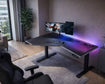
Corner desks can provide additional surface area for these accessories while helping create a defined gaming station.
Before choosing a desk for gaming, consider cable routing and the location of electrical sockets. A desk may look extremely tidy when empty but become much harder to organise once several powered devices are installed.
Adequate desktop depth is also important. Your screen should not feel uncomfortably close simply because the desk lacks sufficient front-to-back space.
L-shaped corner desks explained
L-shaped models are among the most recognisable types of corner desks.
As the name suggests, the desktop forms an L shape, usually providing one primary section and a return extending at approximately a right angle.
This configuration can be extremely versatile.
One section can function as the primary workstation while the return provides additional surface space. Alternatively, the two sides can be used for completely different purposes.
The dimensions of both sections should be checked carefully because photographs can make the proportions difficult to judge.
A desk described as L-shaped might have two similarly sized sections or one substantially shorter return.
Reversible corner desks
Room layouts vary considerably, which makes desk orientation important.
Some corner desks are reversible, meaning the return can be installed on either the left or right side. Others have a fixed orientation.
A reversible design can offer greater flexibility, particularly if you move house or reorganise your room in the future.
However, never assume that an L-shaped desk is automatically reversible.
Shelving, support frames, drawers and structural components can determine which way the desk must be assembled. Always check the specification before ordering.
Left-hand and right-hand corner desks
When a design is not reversible, you may need to choose between left-hand and right-hand configurations.
This is an important decision.
Think about the position from which you will actually sit at the desk and where you want the return section to be located.
A simple floor plan can help.
Draw the room from above and mark the doors, windows and other furniture. Then sketch the proposed desk into the corner.
This basic step can prevent an expensive mistake and make it easier to visualise how much circulation space will remain.
Corner desks with storage
Storage can significantly increase the practicality of a workstation.
Some corner desks incorporate drawers, cupboards, open shelving or raised shelves.
This can be particularly useful in rooms where there is limited space for separate office storage.
Before deciding that more storage is automatically better, consider what you actually need to store.
Deep cupboards may be useful for larger items, while drawers can work better for stationery and smaller accessories. Open shelving provides quick access but means everything remains visible.
Integrated storage can also reduce available legroom or limit how the desk can be assembled, so examine the complete layout rather than focusing only on storage capacity.
Corner desks with shelves
Shelving can make effective use of vertical space.
Instead of expanding the footprint of the desk, shelves allow frequently used items to be positioned above or alongside the main work surface.
This can be useful for books, small office accessories and decorative items.
However, pay attention to the height and position of shelves if you use monitors.
A shelf that appears practical in a product image could potentially restrict the size or placement of a large screen.
Measure your existing equipment before purchasing.
Corner desks without storage
Not everybody needs drawers and shelves.
Minimalist corner desks can provide a cleaner appearance and often maximise the amount of open space beneath the desktop.
This can be advantageous if you use a large office chair, want greater freedom of movement or already have separate storage elsewhere in the room.
A simpler frame can also make cable management easier because there are fewer enclosed sections to work around.
For people who primarily want maximum working surface rather than storage, a straightforward L-shaped design can be an excellent option.
Choosing the correct size corner desk
Desk dimensions are one of the most important considerations when shopping online.
Never judge size from photographs alone.
You should check:
-
overall width
-
length of each side
-
desktop depth
-
overall height
-
internal leg space
-
dimensions of storage sections
-
distance between shelves
-
maximum recommended load where specified
Use a tape measure to map the dimensions directly onto your floor.
For an even clearer indication, temporary masking tape can be used to mark the approximate footprint.
This makes it much easier to understand how the desk will affect the room.
How much space do you need around a corner desk?
A desk that fits between two walls is not necessarily a desk that fits comfortably into the room.
You also need room for the user.
Allow sufficient space for your chair to move backwards and for you to enter and leave the workstation comfortably.
If another person regularly needs to walk behind your chair, additional clearance will be required.
Doors and cupboards should still be able to open properly.
Planning these details before ordering can make the difference between a workstation that feels spacious and one that makes the entire room feel cramped.
Desktop depth matters
Width often receives most of the attention, but desktop depth can be equally important.
A shallow desk might be adequate for a laptop. A setup involving a monitor, keyboard and other equipment may benefit from considerably more depth.
Think about how you work.
If you regularly place documents between yourself and your keyboard, you will require additional front-to-back space. If you use monitor stands or larger equipment, account for those as well.
The most suitable dimensions are therefore determined by your actual setup rather than a universal ideal measurement.
Materials used for corner desks
Corner desks are available in numerous materials and finishes.
Engineered wood and wood-effect surfaces are common because they can provide a wide variety of colours and styles while remaining practical for everyday use.
Metal frames are also frequently used, particularly in contemporary and industrial-style designs.
Some desks combine a metal structure with a wood-effect desktop, creating a balance between visual warmth and a more minimalist frame.
When comparing materials, consider durability, maintenance, weight and how the finish will coordinate with your room.
Choosing the right colour
Colour can have a surprisingly large effect on how substantial a desk appears within a room.
White and lighter finishes can complement bright contemporary interiors and may make large furniture feel visually lighter.
Black and darker finishes can create a stronger, more defined appearance and are often popular for modern offices and gaming rooms.
Wood-effect finishes can introduce warmth and work well with a broad range of interiors.
Rather than choosing a colour in isolation, consider the desk alongside your flooring, wall colour, office chair and existing furniture.
Cable management for corner desks
Modern workstations can involve a remarkable number of cables.
Computers, monitors, lamps, chargers, speakers and other equipment can quickly turn an otherwise organised desk into a tangle of wires.
Plan cable management while setting up the desk rather than waiting until everything is connected.
Depending on the desk design, useful approaches may include under-desk cable trays, clips, ties and carefully positioned extension leads.
Also consider where your wall sockets are located before deciding which corner of the room to use.
Keeping cables organised does more than improve appearance. It can make cleaning easier and reduce the inconvenience of identifying individual power leads later.
How to organise a corner desk effectively
One advantage of a corner layout is the ability to divide the desktop into zones.
Keep the equipment you use most frequently within easy reach.
Your primary screen and keyboard will usually occupy the central working area. Less frequently used equipment can then be positioned along the return.
Avoid filling every available centimetre simply because the space exists.
Some clear desktop space is valuable for paperwork, writing and temporary tasks.
A well-organised large desk can feel calmer and more practical than a cluttered one.
Where should you position a corner desk?
The obvious answer is a corner, but not every corner is equally suitable.
Look at natural light, windows, radiators, sockets and foot traffic.
Placing a workstation close to natural daylight can create a pleasant working environment, but screen glare may become an issue if the monitor directly faces a bright window.
Radiators should not be unnecessarily obstructed, and electrical sockets should remain reasonably accessible.
Also consider what will appear behind you during video calls if you regularly work remotely.
A little planning can substantially improve the final setup.
Are corner desks good for productivity?
Furniture cannot create productivity by itself, but a practical workspace can remove some everyday frustrations.
Having enough room to organise your equipment, documents and accessories means less time spent moving items around to complete different tasks.
A dedicated workstation can also help create a clearer distinction between work and leisure, particularly when working from home.
The important factor is selecting a desk that suits your working habits.
A huge desktop is not automatically better if most of it remains unused. Equally, choosing a desk that is too small can lead to constant clutter.
Corner desks versus straight desks
Both designs have advantages.
Straight desks can be simple, compact and easy to position against a single wall. They can be an excellent solution when your requirements are modest or your room has a suitable uninterrupted wall.
Corner desks generally become more attractive when you need additional surface area or want to make use of two adjoining walls.
The decision should therefore be based on your room and working requirements rather than assuming one design is universally superior.
Ask yourself what equipment you need on the desktop, how much room you have available and whether you would genuinely use the second working section.
Common mistakes when buying corner desks
One of the most common mistakes is failing to measure properly.
Another is overlooking orientation.
Buyers may also focus on overall width while forgetting about desktop depth, chair clearance or the dimensions of shelving.
Other mistakes include failing to account for skirting boards, assuming a desk is reversible, forgetting about nearby radiators and not considering where cables will run.
Product dimensions should always be checked carefully before ordering.
Taking ten minutes to measure your room properly can prevent significant inconvenience later.
What to look for when buying corner desks online in the UK
When comparing corner desks online, start with practical requirements before appearance.
Consider the following:
-
Does the desk fit the available corner?
-
Is the orientation correct?
-
Is it reversible if you require flexibility?
-
Is the desktop large enough for your equipment?
-
Is there sufficient depth for your preferred setup?
-
Does it provide enough legroom?
-
Do you require drawers or shelves?
-
Will your chair fit comfortably?
-
Can cables be routed conveniently?
-
Does the style complement the room?
Once these questions have been answered, you can compare finishes and design details with far greater confidence.
Creating a complete workspace around your corner desk
The desk should form the foundation of your workstation rather than being considered independently.
A comfortable chair is particularly important if you spend long periods sitting.
Lighting also deserves attention. Natural light is valuable during the day, while a suitable desk or room light can help create a comfortable environment during darker mornings and evenings.
Keep commonly used equipment accessible and move unnecessary items away from the immediate working area.
If your desk does not include storage, nearby shelving or a compact drawer unit can provide additional organisation without overwhelming the room.
The objective is to create a workspace where everything you regularly need has a sensible place.
Are corner desks worth it?
For the right room and user, corner desks can be an extremely practical investment.
They are particularly well suited to people who want a generous work surface, use multiple screens, require separate working zones or have an underused corner available.
They can also be valuable in compact rooms where space needs to work harder.
The most important factor is matching the desk to the room.
Measure carefully, check orientation, consider your equipment and think realistically about how you will use each part of the desktop.
When these factors are considered properly, a corner desk can turn an awkward part of a room into one of its most useful areas.
Finding the right corner desks for your space
There is no single design that will suit every home.
Some people need a substantial L-shaped workstation capable of accommodating several monitors. Others simply want a compact desk that fits neatly into a bedroom corner.
Some prioritise drawers and shelving, while others want an uncluttered desktop and maximum legroom.
That variety is precisely why it is worth comparing corner desks according to function rather than choosing on appearance alone.
Begin with the space available, determine how much desktop area you genuinely need and then decide which additional features would make everyday use easier.
A desk should make your room work better, not simply fill an empty corner.
Conclusion
Corner desks offer a practical way to create a spacious and organised workstation while making intelligent use of the layout of a room.
Their versatility makes them suitable for home offices, bedrooms, study areas, gaming setups and professional environments throughout the UK. From compact designs for smaller spaces to substantial L-shaped workstations with integrated storage, there are configurations to suit a wide range of requirements.
The key to choosing successfully is preparation.
Measure both walls carefully. Check the depth and orientation. Consider your chair, monitors, storage requirements, sockets and surrounding furniture. Think about how you actually work rather than simply selecting the largest desk that will fit.
The right desk should provide enough room for everything you need without making the surrounding space uncomfortable.
With careful planning, an unused corner can become a highly functional workspace that feels organised, comfortable and purpose-built for the way you work.
FAQ SECTION
What are corner desks used for?
Corner desks are designed to create a workstation that makes practical use of the corner of a room. They can be used for home working, studying, gaming, business administration, computer use and other desk-based activities.
Are corner desks good for small spaces?
Corner desks can be excellent for small spaces when the dimensions are chosen carefully. By using two adjoining walls, a corner configuration can provide useful desktop space without requiring one extremely long uninterrupted wall.
Are corner desks the same as L-shaped desks?
Many corner desks are L-shaped, but the terms do not always describe exactly the same design. Some corner desks are compact units specifically shaped for a corner, while L-shaped desks generally have two distinct desktop sections extending at approximately a right angle.
Can corner desks be reversed?
Some can, but not all corner desks are reversible. Certain models allow the return to be assembled on either side, while others have a fixed left-hand or right-hand orientation. Always check the product specification before purchasing.
How do I measure for a corner desk?
Measure outward from the corner along both walls and check the maximum available length on each side. You should also measure how far the desk can project into the room. Account for doors, windows, radiators, skirting boards, sockets and nearby furniture.
How much room should I leave behind my office chair?
You need enough clearance to move your chair backwards and enter or leave the desk comfortably. The exact amount required depends on your chair and room layout. If people need to walk behind the chair, allow additional circulation space.
Are corner desks suitable for two monitors?
Many corner desks provide sufficient surface area for dual-monitor setups, but suitability depends on the dimensions and construction of the individual desk. Check the available desktop width and depth as well as any stated weight limitations.
Are corner desks good for working from home?
Corner desks can be particularly useful for home working because they can provide a substantial working surface and create a clearly defined office area. They may also provide room to separate computer work from paperwork and other tasks.
Can you put a corner desk in a bedroom?
Yes. A corner desk can be a practical option for a bedroom, particularly when the room needs to serve as both a sleeping and working space. Compact designs can make effective use of an otherwise unused corner.
Are corner desks suitable for gaming?
Yes. The additional desktop area available with many corner desks can accommodate monitors, keyboards, speakers and gaming accessories. Check the dimensions carefully and consider cable management before choosing a model.
Should I choose a corner desk with storage?
That depends on what you need to keep near your workstation. Drawers, shelves and cupboards can be useful if you need office storage but have limited room for separate furniture. A desk without storage may provide more open leg space and a cleaner appearance.
What is the best position for a corner desk?
The best position depends on the layout of your room. Consider natural light, screen glare, electrical sockets, radiators, windows, doors and the movement of people through the room before deciding where to place the desk.
What colour corner desk is best for a small room?
Lighter colours can help larger pieces of furniture feel less visually dominant, but the best choice depends on the surrounding décor. White, wood-effect, black and other finishes can all work successfully when coordinated with the rest of the room.
How do I keep a corner desk organised?
Divide the desktop into functional zones. Keep frequently used equipment in the primary working area and place less frequently used items along the return. Cable management and appropriate storage can also help maintain a clean and practical workstation.
What should I check before buying corner desks online?
Check the overall dimensions, orientation, desktop depth, legroom, storage configuration, materials and assembly requirements. You should also measure your room carefully and ensure doors, windows, radiators and surrounding furniture will remain accessible.